All published articles of this journal are available on ScienceDirect.

Cross Reactivity of Acute Generalized Exanthematous Pustulosis Among Proton Pump Inhibitors: Case Report

Abstract
Introduction
Acute generalized exanthematous pustulosis (AGEP) is an acute pustular eruption characterized by widespread nonfollicular sterile pustules. AGEP is a rare adverse drug reaction with an incidence of 1 to 5 cases per million per year. This condition was accidentally discovered in a patient treated with two different proton pump inhibitors (PPIs) consecutively.
Case Presentation
A 47-year-old male developed pustulosis within a couple of hours after being injected with pantoprazole 40 mg. After 3 days of stopping pantoprazole, the patient was injected with lansoprazole 30 mg, and pustulosis redeveloped.
Discussion
Several studies have reported that pantoprazole can induce AGEP in sensitive patients, but the incidence is rare. In the current case, two different PPI drugs induced the condition in the same patient. This showed cross-reactivity between pantoprazole and lansoprazole in inducing AGEP. The current study is the first case report on cross-reactivity of PPIs in AGEP.
According to previous results, cross-reactivity in PPIs is largely due to a similar chemical structure. Omeprazole, esomeprazole, and pantoprazole have changed their benzimidazole rings, while lansoprazole and rabeprazole have modified their pyridine rings. Therefore, cross-reactivity is often observed within the same group of benzimidazoles or pyridines. In the current case, the cross-reactivity cannot be explained by those patterns. A safe alternative PPI can be identified by a skin test, which has high specificity for immediate hypersensitivity reactions to PPIs.
Conclusion
Based on the results, pantoprazole and lansoprazole led to the consecutive induction of AGEP. Cross-reactivity between both drugs cannot be explained by the general patterns in PPIs. Therefore, individuals who show hypersensitivity to pantoprazole must undergo a skin test before receiving another PPI.
1. INTRODUCTION
Acute generalized exanthematous pustulosis (AGEP) is a rare and severe subtype of skin reaction, characterized by acute, extensive, non-follicular intradermal pustules within a large erythematous background. It is often accompanied by pyrexia, pruritus, burning sensation, and leukocytosis. A report showed that almost 90% of cases were induced by drugs, such as antibiotics, pristinamycin, aminopenicillins, quinolones, sulfonamides, (hydroxy)chloroquine, terbinafine, and diltiazem [1]. However, in Korean patients, it was due to herbal medications, lacquer, and radiocontrast media [2]. These eruptions show an immunologic adverse drug reaction (ADR) and occur only in hypersensitive individuals [3].
Proton pump inhibitors (PPIs) are a class of drugs widely used to reduce gastric acid secretion, which often accompanies or is a consequence of diseases that trigger or are triggered by active gastric acid secretion. While this class of drugs is generally safe, their widespread use increases the risk of adverse drug reactions due to their diagnostic complexity and potential severity [4]. Hypersensitive skin reactions (HSR) to PPIs have been reported and classified as immediate or nonimmediate/delayed, with symptoms varying from mild symptoms to life-threatening disorders. The symptoms include urticaria, angioedema and anaphylaxis, maculopapular eruption, contact dermatitis (occupational), photoallergic dermatitis, erythroderma, drug reaction with eosinophilia and systemic symptoms (DRESS) syndrome, Stevens-Johnson syndrome/toxic epidermal necrolysis (SJS/TEN) [5]. Since PPIs share a common chemical structure composed of benzimidazole and pyridine rings, there is an allegation that this underlies the cross-reactivity (CR) patterns observed in immediate-type HSRs. Widespread CR among PPIs has been reported with rates reaching up to 61.6%, and approximately 8.9% of patients may exhibit CR to all available PPIs [6].
The Drug Provocation Test (DPT) has been used as the gold standard to assess CR; however, a prolonged interval between the reaction and testing may further reduce diagnostic sensitivity. It does not offer absolute assurance, since a mild cutaneous reaction is observed instead of a negative DPT [4]. The lack of test confirmation in real practice reflects the multifactorial diagnostic challenges.
Our case report illustrates a patient with two consecutive episodes of AGEP after exposure to pantoprazole and lansoprazole, and it is classified as clinical CR based on a strong clinical history only.
1.1. Case Presentation
A 47-year-old man presented to the ED of Dr. Ramelan Navy Hospital after being treated at a private hospital. He received metamizole and pantoprazole injections for abdominal pain. He was sent home after his condition improved (1 hour at the ED). Hours after he arrived home, he developed a very itchy rash. Instead of a rash, there were pustules resembling small pimples on the face and in some body folds, as shown in Figs. (1–3). He was admitted to the Navy Hospital and sent to the Surgical Ward due to USG results from the previous hospital, which revealed a gallstone.
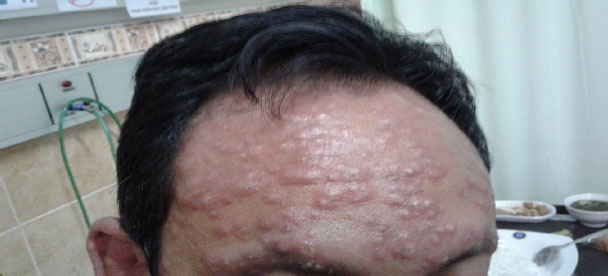
Pustules on face.
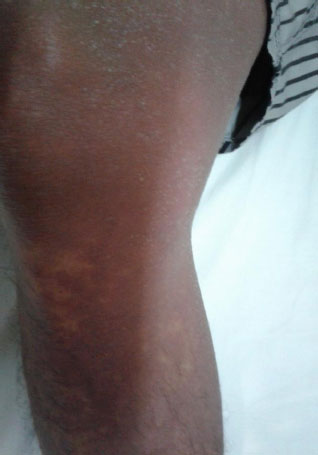
Pustules and rash on the right leg.
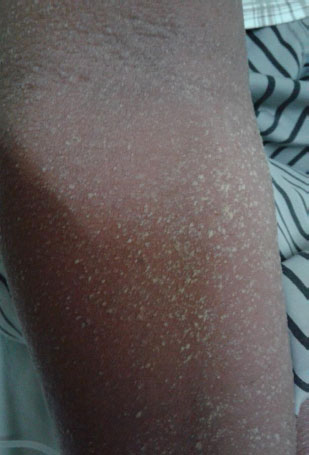
Pustule and rash on the fold of the left arm.
This patient was diagnosed with AGEP by a dermatologist, who then consulted a clinical pharmacist.
1.2. Clinical Results
A 47-year-old man presented with fever (38°C), an itchy, erythematous rash accompanied by pustules all over the face and at the extremities, as shown in Figs. (1–3). The sclera appeared yellowish, supported by a slight increase in total bilirubin, which was 3.76 mg/dl (Table 1). In addition, there was an increase in transaminase levels of more than 3 times the Upper Limit of Normal (ULN) (Table 1).
| Parameter | On Admission | 3 Days After Admission | 6 Days After Admission |
|---|---|---|---|
| WBC (4,0-10.0) | 10,300 | 9,650 | 9,790 |
| Eosinophil (0.02-0.5) | - | 1.55 | 0.53 |
| ALT (0-37 U/l) | 206 | 50 | 86 |
| AST (0-35 U/l) | 113 | 78 | 98 |
| Total Bilirubin (<1mg/dl) | 3.76 | 2.53 | 2.3 |
| Direct-Bilirubin (0.0-0.8 mg/dl) | 2.47 | 1.73 | 1.5 |
| Na (135-155 meq) | 126,4 | - | - |
The digestive surgeon defined the differential diagnosis as cholangitis with cholecystitis, which was supported by USG results from the previous hospital, and planned to operate on the patient once the dermatological problem was resolved. However, after the AGEP was resolved, jaundice was cleared, and the total transaminase levels returned to normal values, leading to cancellation of the operation.
The laboratory results are as follows:
1.3. Timeline
The following was the timeline as describe at (Fig. 4).
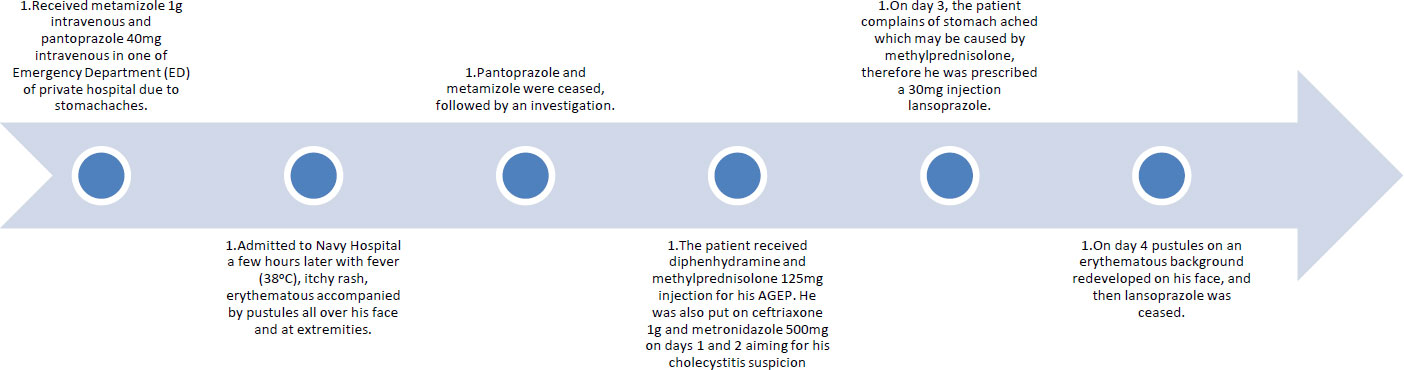
Timeline of AGEP incidence after pantoprazole and lansoprazole injection.
(1) Received metamizole 1g intravenous and pantoprazole 40mg intravenous in one of the Emergency Departments (ED) of a private hospital due to stomachaches.
(2) Admitted to Navy Hospital a few hours later with fever (38°C), itchy rash, erythematous, accompanied by pustules all over his face and at both extremity folds. The patient's rash initially appeared on the forehead, then progressed to the right leg and the left arm fold. There was no mucosal involvement, no history of infection, and no history of autoimmune disease.
(3) Pantoprazole and metamizole were ceased, followed by an ADR investigation.
(4) The patient received diphenhydramine and methylprednisolone 125mg injection for the AGEP and was placed on ceftriaxone 1g and metronidazole 500mg on days 1 and 2, pending cholecystitis suspicion.
(5) On day 3, the patient complained of stomachache acting up again, which could be caused by methylprednisolone, and a 30mg injection of lansoprazole was prescribed every 12 hours.
(6) On day 4, pustules on an erythematous background redeveloped at the same site on the patient’s face, and lansoprazole was then discontinued.
1.4. Diagnostic Assessment
The patient was diagnosed with AGEP based on the presence of many small pustules that developed with a large erythematous background, starting from the face to the extremities, fever, and abnormal liver function tests (Table 1). On day 4, pustules with an erythematous background redeveloped at similar sites after lansoprazole injection. A Drug Provocation Test (DPT) was not performed to prove Cross-Reactivity (CR). Therefore, this case was investigated as an ADR.
The investigation began with determining the type of ADR, followed by severity assessment, pharmacokinetic assessment, and causality assessment. The results were as follows.
(1) The type of ADR was B, which means bizarre, non-dose-related type [7].
(2) Hartwig’s scale severity assessment showed a level 4 severity. Level 4 of severity explains that ADR was the only reason for the admission and the need to stop the suspicious drug. The investigation then focused on metamizole and pantoprazole, which were administered in the previous hospital.
(3) Quick ADR analysis using the third literature (such as Drug Information Handbook, Lexidrugs app) showed that both drugs had the potential to induce a rash.
(4) Pharmacokinetic assessment began with the determination of the half-lives of metamizole, pantoprazole, and lansoprazole. Each half-life was paired with the onset of ADR, and metamizole did not match the onset of ADR, thereby continuing pantoprazole. After finding a matched drug, the primary literature was searched in the PubMed database and yielded only 1 case report of metamizole-induced AGEP [8], 1 case report of pantoprazole-induced AGEP [9], and 1 case report of lansoprazole-induced AGEP.
(5) The patient had cross-reactivity in AGEP. This was evidenced by the recurrence of AGEP at the same sites 3 days after discontinuation of pantoprazole and the subsequent administration of lansoprazole. According to pharmacokinetic data (half-life), pantoprazole had already cleared from the body within 1–2 days. In addition, this clarified that the patient's repustulosis was strongly induced by lansoprazole. This assumption was also supported by the causality assessment results, which showed “Certain” for both PPI-induced AGEP.
(6) Causality assessment was conducted by applying 2 different tools, namely Naranjo and WHO-UMC Categories. The assessment result from the Naranjo Scale for pantoprazole was 8, which meant “probable”. Meanwhile, the WHO-UMC Causality Categories resulted in “Certain” ADR [10]. The discrepancy between tools was possible because not all questions in Naranjo had been answered yet (Table 2).
| No | Drugs | Severity of ADR | Half Life | Primary Literature Searching |
Causality Assessment Score Naranjo Score WHO Score |
|---|---|---|---|---|---|
| 1 | Metamizole | Level 4 | Approximately 14 minutes | 2 cases | - |
| 2 | Pantoprazole | 1hour; increase to 3,5–10 hour in CYP 2C 19 deficiency |
1 case | 8: Probable Certain |
|
| 3 | Lansoprazole | 1,5±1 hour | 1 case | 8: Probable Certain |
1.5. Therapeutic Intervention
Therapeutic interventions included pharmacologic and non-pharmacologic treatments. Pharmacologic treatment comprised diphenhydramine injection and methyl prednisolone injection. Non-pharmacologic intervention was stopping the suspected drug. Therefore, quickly and accurately identifying the suspected drug was very important.
1.6. Follow-up and Outcomes
The pustules and rash disappeared after pantoprazole and metamizole were discontinued for 3 days. The liver function test results, such as AST and total bilirubin, decreased to almost normal values (Table 1). However, on day 3, lansoprazole was administered because of a stomachache after methylprednisolone injection. The next morning, the rash and pustules reappeared at the same sites.
2. DISCUSSION
AGEP presents with rapidly developing pustular eruptions, accompanied by fever, pruritus, systemic discomfort, and other organ involvement [11]. This is in accordance with our case. Many cases of AGEP due to PPIs have been reported individually [9, 12]. Pantoprazole showed the strongest correlation with AGEP, followed by other PPIs. The median time to the onset of AGEP was 6 days after PPI treatment, and 60.00% to 83.33% of patients developed symptoms within 10 days after the medication (except rabeprazole). PPI-associated AGEP generally led to a fatality rate of 1.86% (3 cases) and a hospitalization rate of 79.50% (128 cases), as reported by Zhao et al. [13]. In our case, the onset of AGEP was less than 1 day. This was the first report on cross-reactivity of PPIs in AGEP.
CR has become a challenge in PPI selection in the clinical setting. Patients who are allergic to omeprazole, esomeprazole, or pantoprazole show the highest rate of CR. Meanwhile, patients who are allergic to lansoprazole or rabeprazole show a lower rate of cross-reactivity [6]. It was initially thought that the similarity in the chemical structure of the benzimidazole core in PPIs influenced the development of CR. However, scientific evidence has increasingly emerged that CR patterns are not determined by structural similarity. Cross-reactivity exists among the various PPIs, but the patterns of cross-reactivity vary [14]. Cross-reactivity was found among the same groups of benzimidazole or the pyridine group. In this case, the cross-reactivity could not be explained by those patterns. The different patterns of cross-reactivity may be associated with the chemical characteristics (e.g., substitutions, metabolites) and metabolism of the drugs, drug-related cofactors, and shared immunological factors [6, 15].
The strengths of this case include being the first report of CR between pantoprazole-lansoprazole- induced AGEP.
CONCLUSION
In conclusion, pantoprazole and lansoprazole induced AGEP consecutively. The ADR is categorized as bizarre and non-dose-related, with a level 4 severity and causality scale according to the WHO-UMC Causality Categories of “Certain”. Cross-reactivity in AGEP is observed in this case, which is evidenced by the recurrence of AGEP on day 4 when lansoprazole was given. CR was classified as clinical CR based on a strong clinical history.
Some limitations of this case report should be acknowledged. Although the clinical course and temporal relationship strongly suggest pantoprazole and lansoprazole as the culprit drugs, the absence of DPT represents a limitation. Furthermore, this is a single case report, and the findings cannot be generalized to a broader patient population. Future studies with larger cohorts and longer follow-up will be needed to validate these observations.
LEARNING POINTS
(1) AGEP is one of the ADRs with an immunologic mechanism.
(2) Skin eruption accompanied by hepatocellular dysfunction and cholestasis was prominent. Systemic involvement, specifically hepatitis, must not be overlooked in patients with AGEP.
(3) Withdrawal of the implicated drug is essential to avoid further hepatic injury.
(4) PPI may induce AGEP and CR; therefore, skin testing and drug provocation testing (DPT) are important to identify safe alternatives and ensure close patient monitoring.
AUTHORS’ CONTRIBUTIONS
The authors confirm their contributions to the paper as follows: W.W: The conception and design were performed; W.W. and E.R.: Data collection was conducted; W.W., Y.R., and E.R.: Data analysis and interpretation were performed; W.W.: The manuscript was written. Final approval of the manuscript was provided by all authors.
LIST OF ABBREVIATIONS
| ADR | = Adverse Drug Reaction |
| AGEP | = Acute Generalized Exanthematous Pustulosis |
| AST | = Aspartate Aminotransferase |
| CR | = Cross-reactivity |
| DPT | = Drug Provocation Test |
| PPI | = Proton Pump Inhibitor |
ETHICS APPROVAL AND CONSENT TO PARTICIPATE
The study was approved by the Ethics Committee of Dr. Ramelan Naval Central Hospital, Indonesia with approval no. 166/EC/KEP/2025.
HUMAN AND ANIMAL RIGHTS
All procedures performed in studies involving human participants were in accordance with the ethical standards of institutional and/or research committees and with the 1975 Declaration of Helsinki, as revised in 2013.
AVAILABILITY OF DATA AND MATERIALS
The data supporting the findings of the article is available in the Unhan repository at https://lib.idu.ac.id.
ACKNOWLEDGEMENTS
Declared none.